In today’s world of sports, fitness, and team activities, clothing has become much more than a practical uniform. Teamwear represents identity, unity, confidence, and belonging. As teams look for ways to stand out, cultural inspiration offers an exciting opportunity to create designs that are both visually distinctive and meaningful. One particularly rich source of inspiration is Korean culture, with its beautiful combination of traditional symbolism, elegant aesthetics, vibrant colors, and centuries-old craftsmanship.
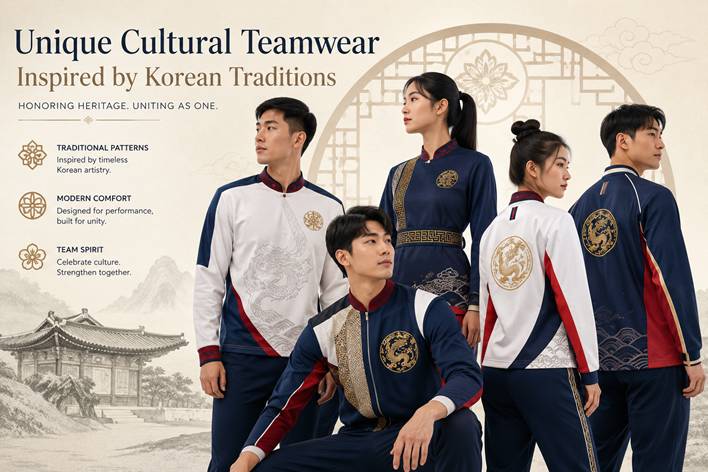
Unique cultural teamwear inspired by Korean traditions brings together the energy of modern sportswear with the visual language of Korea’s cultural heritage. From the graceful lines of hanbok to the symbolism of traditional Korean patterns, these design elements can transform ordinary uniforms into memorable pieces of team identity. When thoughtfully adapted, Korean-inspired teamwear can celebrate cultural heritage while still meeting the performance needs of modern athletes.
The Growing Appeal of Cultural Teamwear
Team uniforms traditionally focus on practicality. They need to be comfortable, durable, breathable, and suitable for physical activity. However, modern teams increasingly want their uniforms to communicate something about who they are. A distinctive design can strengthen team spirit, create a recognizable visual identity, and help players feel connected to something larger than themselves.
Cultural teamwear takes this idea one step further. Instead of relying only on generic stripes, numbers, and color combinations, designers can draw inspiration from a specific cultural tradition. This creates opportunities for storytelling through clothing.
Korean culture is especially suitable for this approach because it offers a wide range of visual references. Traditional clothing, architecture, decorative arts, calligraphy, nature-inspired imagery, and symbolic motifs can all provide inspiration. The challenge is to reinterpret these elements in a way that feels contemporary rather than simply copying traditional garments.
The result can be a uniform that feels modern on the field while subtly referencing Korean heritage.
Korean Traditional Patterns and Motifs
Patterns provide another powerful way to introduce cultural identity into teamwear. Korean traditional decorative arts contain many motifs inspired by nature, architecture, mythology, and symbolism.
Designers can draw inspiration from floral forms, clouds, waves, geometric patterns, and other traditional decorative elements. These motifs can be simplified and transformed into repeating graphics suitable for modern athletic clothing.
For example, a subtle pattern could run along the sides of a jersey or appear inside the collar. A traditional-inspired graphic could be incorporated into the sleeves without overpowering the team logo or player number.
This approach is particularly effective because it allows cultural references to remain elegant and understated.
A team could also create a custom pattern specifically for its identity. Rather than using a standard traditional motif, designers might develop a new graphic based on Korean-inspired shapes, colors, and symbolism. This gives the team something unique while maintaining a connection to Korean aesthetics.
Korean Calligraphy and Typography
Typography can also contribute to culturally inspired teamwear. Korean writing, particularly Hangul, has a distinctive visual character that can add an immediately recognizable element to a uniform.
Teams can incorporate Hangul in carefully selected areas, such as the back of a jersey, sleeve details, warm-up jackets, or promotional apparel. A Korean word representing concepts such as strength, unity, courage, or determination can become part of the team’s visual identity.
However, accuracy and cultural respect are essential. Korean text should be translated and reviewed by someone who understands the language rather than being selected solely because it looks visually interesting.
Hangul-inspired geometric qualities can also influence the design of numbers and lettering without directly using Korean words. This can create a subtle visual connection between traditional Korean writing and contemporary sports typography.
Modern Performance Meets Traditional Style
While appearance is important, teamwear must ultimately perform. Athletes need garments that allow unrestricted movement and help them remain comfortable during intense activity. This is where modern custom active wear manufacturing becomes important. Korean-inspired designs can be printed, sublimated, embroidered, or incorporated into technical fabrics without sacrificing performance.
Modern athletic fabrics can provide moisture management, stretch, breathability, and durability. Sublimation printing, for example, allows complex patterns and gradients to become part of the fabric itself. This makes it possible to use detailed Korean-inspired graphics while maintaining a lightweight garment.
The design process should therefore begin with both aesthetics and performance in mind. Designers need to consider where graphics are positioned, how seams affect movement, and how colors will appear on technical materials.
A successful cultural uniform should look distinctive but still feel like serious sportswear.
Team Identity Through Korean-Inspired Designs
A uniform becomes more meaningful when it tells a story. Korean-inspired teamwear can help teams establish an identity around concepts such as discipline, harmony, resilience, respect, and collective achievement.
For example, a martial arts club could incorporate traditional Korean visual elements into its uniforms to reinforce its connection to Korean martial arts heritage. A school sports team might use Korean-inspired colors and patterns as part of an international cultural exchange program. Corporate sports teams could also adopt Korean-inspired designs for international events, particularly when the company has connections with Korea or wants to celebrate Korean culture.
The design can be customized according to the team’s personality. A competitive team might prefer strong geometric patterns and darker colors, while a community group might choose softer colors and nature-inspired graphics.
Cultural Respect and Authenticity
Cultural inspiration should always be approached with respect. There is an important difference between appreciating a culture and using cultural symbols without understanding them.
Designers should research the meaning behind traditional motifs, colors, garments, and symbols before incorporating them into teamwear. If Korean language is included, professional translation should be considered. If a traditional symbol has a specific religious, historical, or ceremonial meaning, designers should understand whether it is appropriate for casual sports clothing.
Authenticity does not mean reproducing historical clothing exactly. Instead, it means understanding the source material and adapting it thoughtfully.
Collaboration can make the process even stronger. Working with Korean designers, artists, cultural specialists, or members of the Korean community can provide valuable perspectives and help avoid accidental misuse of cultural elements.
The best cultural teamwear feels appreciative, informed, and purposeful.
Creating a Signature Team Collection
One of the advantages of Korean-inspired design is that the concept can extend beyond the main jersey. A complete team collection can include match uniforms, training shirts, hoodies, tracksuits, jackets, shorts, caps, bags, and other accessories.
For example, the primary jersey might feature a bold Korean-inspired pattern, while the training shirt uses a simplified version of the same graphic. A tracksuit could incorporate traditional-inspired color blocking, and a hoodie might feature a small Hangul detail. Teams can also create home and away kits using different interpretations of the same cultural concept. One uniform could feature a dark base with vibrant accents, while the second uses white or another lighter color.
This approach gives players variety while ensuring that every piece remains connected to the team’s identity.
Personalization for Players
Modern teamwear is increasingly personalized. Player names, numbers, positions, and individual details can be integrated into culturally inspired designs.
A particularly interesting approach is to combine Western sports numbering with subtle Korean-inspired typography or graphics. Player names can appear in standard Roman letters, while a Korean word or phrase appears as a small design element. Personalization can also extend to team roles. Captains might receive a special sleeve detail, while coaches and support staff can have coordinated versions of the same design.
The goal is to create a sense that every individual belongs to the same visual family.
Korean-Inspired Teamwear Beyond Sports
Although sports are a natural application, culturally inspired teamwear has many other uses. Dance groups, university societies, cultural organizations, esports teams, fitness clubs, and corporate teams can all benefit from distinctive designs.
Dance groups, for instance, can use flowing patterns and vibrant colors inspired by traditional Korean aesthetics. Esports teams can take a more futuristic approach, combining Hangul-inspired typography with neon colors and digital graphics.
Cultural organizations can use teamwear to promote Korean heritage during festivals, exhibitions, international events, or educational programs.
This versatility makes Korean-inspired design relevant to a wide range of modern communities.
Why Unique Designs Matter
In a crowded marketplace, generic uniforms can make teams look interchangeable. A unique design creates recognition. When players walk onto a field or court wearing a distinctive Korean-inspired uniform, the design can immediately communicate personality. It becomes part of the team’s story and can create memorable visual associations for spectators. Unique teamwear can also improve team pride. Players are more likely to feel connected to uniforms that appear thoughtfully designed rather than mass-produced.
For organizations, distinctive apparel can become a valuable branding tool. Supporters may want to purchase the same jerseys, jackets, or shirts, turning teamwear into both merchandise and functional clothing.
The Future of Cultural Teamwear
As customization technology continues to develop, cultural teamwear is likely to become even more creative. Digital printing, advanced fabric technology, and increasingly sophisticated design software make it possible to create highly detailed garments without compromising athletic performance.
The future may involve even more collaboration between sports brands, designers, cultural organizations, and artists.
Instead of simply placing a traditional symbol on a shirt, designers can build complete visual narratives around cultural concepts. A collection might combine historical inspiration with futuristic graphics, creating something that feels both connected to the past and designed for the future.
Korean culture offers particularly strong opportunities because its traditional visual language can be adapted to minimalist, contemporary, streetwear, and high-performance aesthetics.
Conclusion
Unique cultural teamwear inspired by Korean traditions represents an exciting meeting point between heritage and modern sports fashion. The graceful influence of hanbok, the symbolism of traditional colors, the beauty of Korean patterns, the structure of Hangul, and the inspiration of Korea’s natural landscapes can all contribute to distinctive athletic designs.
Ultimately, teamwear is about more than what players wear. It is a visual expression of unity, ambition, culture, and belonging. By creatively and respectfully integrating Korean traditions into contemporary athletic design, teams can create uniforms that are not only functional and stylish but also meaningful.
A well-designed Korean-inspired team uniform can therefore do more than make a team look different. It can tell a story, one that connects tradition with modernity, individuality with teamwork, and cultural heritage with the energy of today’s sports.