
Konglish 101
An experience in class after teaching for a few days…
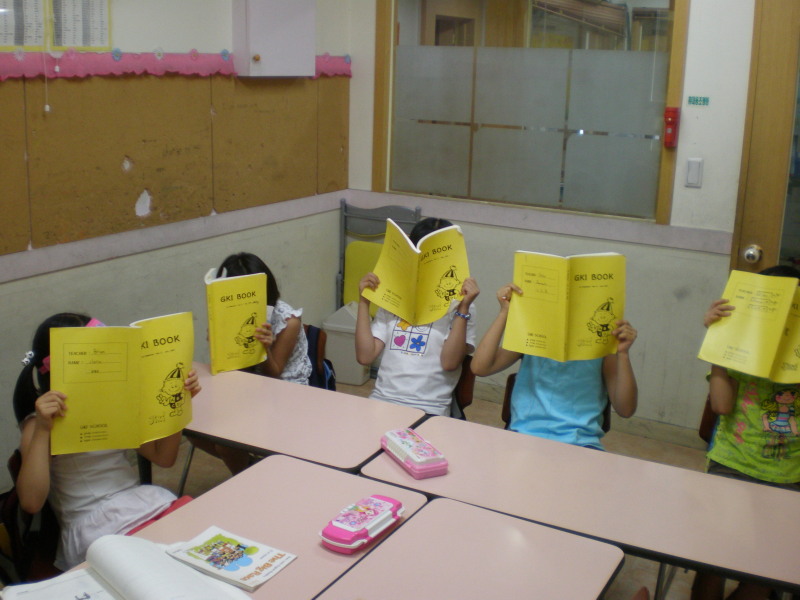
Class: Teacher! John cunning!
Me: I guess. He does seem pretty slick that, John.
Class: No, teacher! Cunning!
Me: Okay, but he’s not master spy or anything.
Then I got blank looks and more screams of Cunning!
So that was introduction to the wonderful world of Konglish. Med Magazine defines Konglish as:
Konglish can be broken down into four types: (1) words whose meanings have been altered; (2) words that have been fabricated to mean something entirely different from the borrowed word or phrase; (3) words in which the pronunciation has changed; (4) and words or phrases which have been abbreviated. Konglish also incorporates ‘pseudo loan-words’: English terms that are used by Koreans but only after making a direct translation from Korean to English. One of the more obvious examples is the word Konglish, which is formed by taking the initial syllable of Korean (Ko), removing the ‘E’ of English and then combining the remaining parts of the two words.
So here are some of the more interesting Konglish I have heard since being in Korea.
Hand Phone = Cell Phone
Refrigelater = Refrigerator
Salaryman = Businessman
Cunning = Cheating One
Manicure = Nail Polish
Service = Gratuity
Dutch Pay = Paying Dutch
Officetel = Office & Hotel
Just Do Me = Nike‘s Just Do It
Eye Shopping = Window Shopping
Orangee = Orange
Strangee = Strange
That’s just the tip of the iceberg! Do you have any funny Konglish words or sayings to add to the list?
![Reblog this post [with Zemanta]](http://img.zemanta.com/reblog_e.png?x-id=6fe92eaf-7d16-4a33-b178-fdc8141d441a)


Remarkable! Its really remarkable stuff, I have got much
from this, kudos.
I love samesame!
Student pointing out we were wearing the same Korea fighting t-shirts:
"Look teacher! We same same!"
walker=combat boots
.-= Pam´s last blog ..Pamenology =-.
awesome, but I don't get the walker = combat boots connection…am I missing something?
Neither do I! Believe me, I'm just as dumbfounded as you are.
I am an online English teacher to Korean students and just yesterday, my student and I were laughing at the confusion Konglish words bring. Up until yesterday, I thought that being a salary man meant you worked in the accounting division of the company. Another Konglish word: walker=combat boots.
While gratuity is something that is "free" many understand the word as a "tip", and it is rare to receive a "tip" from a server.I would term "service" as "no charge" or "on the house" rather then "gratuity".
"Kill Heels": women's shoes where the heel is more than 10 cm high…
This is a fun one!
My Taekwondo Master (female) often said as a way to encourage us to work harder, "Do better than what you did it!"
Yep, I'm from South La and I say refrigelater all the time 'cause it's fun.
the 'ee' and 'uh' alternate based on the consonant sound and environment of the vowel.</></>My favorite is "Macguyver Knife" for 'swiss army knife'.</></>Check out 'Konglish Lexis' theres a huge resource ran out of there. Actually doing a term paper for my MA on the subject…</></>cheers
Ooh, sweet, thanks for the quiz-uh link-uh.Did I flunk it already?
Look-uh, don't mock-uh my Konglishee.</></>I haven't a clue, actually. But, I scored 10/10 on this Konglish quiz:</></> ;http://www.funtrivia.com/trivia-quiz/Humanities/Konglish-101-203597.html
Now I understand the emphasizing of E on words, but how does Uh come about with the word nice? That's Strangeee
I say nice-uh all the time.